Showing posts with label India. Show all posts

29 Nov 2010

Tramcar in Kolkata


A tramcar is a railborne vehicle which—at least in parts of its route—runs on tracks in streets. It may also run between cities and/or towns (interurbans, Tram-train), and/or partially grade separated even in the cities (light rail or light rapid transit). Trams are usually lighter and shorter than conventional trains and rapid transit trains. However, the differences between these modes of public transportation are blurring. Some trams (for instance Tram-Trains) may also run on ordinary railway tracks, a tramway may be upgraded to a light rail or a rapid transit line, two urban tramways may be united to an interurban, etc. Trams are designed for the transport of passengers and (very occasionally) freight. Most trams today use electrical power, usually fed by a pantograph; in some cases by a third rail or trolley pole. If necessary, they may have several power systems. Certain types of cable car are also known as trams. Another power source is diesel; a few trams use electricity in the streets and diesel in more rural environments. Also steam and petrol (gasoline) have been used. Horse and mule driven trams do still occur.

Since 1980 trams have returned to favour in many places, partly because their tendency to dominate the highway, formerly seen as a disadvantage, is now considered to be a merit. New systems have been built in the United States, Great Britain, Ireland, France and many other countries. Tramways are now included in the wider term "light rail", which also includes segregated systems. Some systems have both segregated and street-running sections, but are usually then referred to as trams, because it is the equipment for street-running which tends to be the decisive factor. Vehicles on wholly segregated light rail systems are generally called trains, although cases have been known of "trains" built for a segregated system being sold to new owners and becoming "trams".

6 Oct 2010

Victoria Memorial, Kolkata


The Victoria Memorial also Known as "White Palace" is a memorial building dedicated to Victoria Queen of the United Kingdom and Empress of India located in Kolkata, India - the capital of West Bengal and a former capital of British India. It currently serves as a museum and a tourist attraction. It is an autonomous organization within the Government of India's Ministry of Culture.

The memorial was designed by Sir William Emerson in an architectural style similar to Belfast City Hall. Earlier asked to design the building in the Italian Renaissance style, Emerson was against the exclusive use of European styles and used Indo-Saracenic style, incorporating Mughal elements in the structure. Vincent Esch was the superintending architect while Lord Redesdale and Sir David Prain designed the gardens. The work of construction was entrusted to Messrs Martin & Co. of Calcutta. The foundation stone of the memorial was laid down in the year 1906, by Edward, the Prince of Wales (later Edward VIII). Apart from being a memorial, the monument was intended to serve as a tribute to the success of the British Empire in India. Lord Curzon was the one who envisaged the main idea of the erection of the Victoria Memorial Hall, which was to serve as the architectural culmination of the Kolkata city.

Even the classical style of the monument was specified by Lord Curzon, the then Viceroy. However, it was Sir William Emerson, a renowned architect, who laid down by the actual plan of the memorial. The design of the structure represents an amazing fusion of British and Mughal architecture. White Makrana marbles were used in the construction of Victoria Memorial Hall and the building was inaugurated in the year 1921. The massive hall is 338 by 228 feet and rises to a height of 184 feet.
Facade of the Victoria Memorial. British government money was not used in its construction at all. Rather, the British Indian states, along with the individuals who wanted some favours from the British government, were the main contributors towards the cost of building the Victoria Memorial Hall.

27 Aug 2010

FDC from India: C.R.Raman Pillai

C.V.Raman Pillai was a playwright of Malayalam literature born on 19 May 1858 to middle class parents. His early education included learning Sanskrit and Ayurveda. He grauduated from the University of Madras. C.V.Raman Pillai is considered a pioneer in the field of Malayalam journalism. He worked with many Malayalam and English dailies.

9 Aug 2010

Two FDC's from India: Postal Heritage Buildings


Delhi GPO was opened in 1855. The post office was given permanent status in 1865 and it started functioning in the present building in 1885.

Shimla GPO was established in 1883 on the site of a house known and as "Conny Lodge", now is one of the oldest post office buildings in the country.

Udagamandalam HPO was the first post offics at Udagamandalam opened in 1826 with an establishment of a writer and two delivery peons. There are no records as to where the office originally was.

Cooch Behar HPO was initially functioning in the building situated in the Purana Post Office Para. Today it covers 8893 sq. ft.

Nagpur GPO, considered the mother institution in the Postal Circle of the Central Province, is housed in a majestic Victorian building, once the seat of erstwhile Postmaster General of CP & Berar.

Lucknow GPO is an example of relatively more contemporary engineering and architecture. Constructed with red bricks and lime stone, iron was not used in its construction.

20 Jul 2010

FDC's from India: Astrological Signs


Many countries and schools thought have their own set of symbols, signs and significant methods of assessing a person or predicting an event. The twelve zodiac signs are represented by figures and symbols and associated with constellations and planets and their old Greek, or Roman or Indian legends.
4 Jul 2010

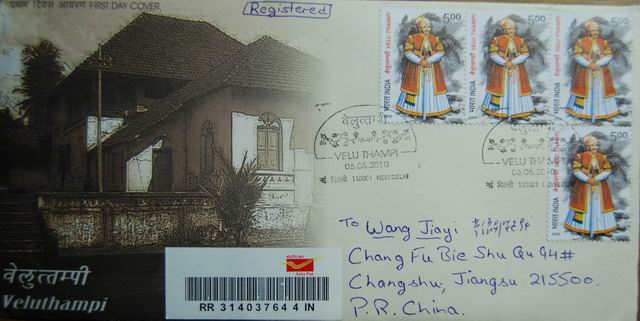
FDC from India: Veluthampi

Veluthampi Dalawa, was born in Thalakkulam village, Kanyakumari District, Tamil Nadu on 6th May 1765. His mother tongue was Malayalam but he was proficient in English, Tamil and Sanskrit. An expert in Ayurveda, Astrology, Tharka Sastra and Mathematics, was also adept in the practice of "Kalaripayattu", the material art of Kerala.

On 29th March,1809 when the British Military surrounded the place of Mannady, Pathanamthitta District, Kerala, he refused to surrender, chossing instead to commit suicide, the death of a hero and martyr in India's Freedom Struggle.

18 Jun 2010

FDC from India: Kanwar Ram Sahib

Kanwar Ram Sahib was born in April 1885 in a small village Jarwar of Sukkur District in Sindh(now in Pakistan) to devout and pious parents. His name Kanwar Ram, in Sindhi denotes "LOTUS". Kanwar Ram Sahib went on to become a luminary of Sindhi people. He advocated peace, nonviolence and communal harmony. He was endowed with a divine voice which he effectively adopted for "Bhagat", a folk-art form of storytelling, with a fusion of song, dance and drama. He radicalized devotional singing and gave a new thrust to Sindhi Soofi lyrical fork music. He divine message of love, unity and peace touched the souls of countless people irrespective of caste, color, creed and religions.

4 Jun 2010

FDC from India: Special Protection Group

The Special Protection Group (SPG) is the executive protection agency of the Government of India. It is responsible for the protection of the Prime Minister of India, other top officials, and their immediate families. The force was established in 1985 after the assassination of Indira Gandhi. It is one of many Indian law enforcement agencies.

The work of the Special Protection Group was more organised after the assassination of Rajiv Gandhi on May 21, 1991, (who was, at that time, not under SPG cover since his term as Prime Minister had ended). After the Rajiv Gandhi assassination, there have been no successful attempts to attack the Prime Minister or the Prime Minister's family members. The Special Protection Group has about 3,000 personnel. Recruits are drawn from police forces as well as National Security Guards commandos, who undergo training similar to that conducted by the United States Secret Service. The officer cadre is mainly Indian Police Service (IPS) officers from various state/central cadres.

The Special Protection Group provides proximate security to protectees, including protection provided from close quarters, journey on foot, road, rail, aircraft, watercraft or any other means of transport, and includes places of functions, engagements, residence, etc. They comprise ring round teams, isolation cordons, the sterile zone, and the rostrum and access control to the person or members of his immediate family. The Special Protection Group, over a period of time, grew both in size as well as in specialisation.

17 May 2010

FDC from India: Muthuramalinga Sethupathy

Muthuramalinga Sethupathy was born on 30 March 1760 at Ramanathapuram to Shri Nerunchithevar and Muthuthiruvirayee Nachiyar.The infant prince , the last Marava ruler, was crowned when he was only 72 days old by his uncle, the King of Ramanthapuram in 1760. His mother acted as Regent and took care of him and ruled over the Kingdom on his behalf, assisted by some wise ministers.

6 May 2010

FDC from India: Vallal Pachaiyappa

Vallal Pachaiyappa was born in 1754 in Periapalayam village near Chennai. He was a Dubhasi who became a revenue collector. He donated for charity and Temples and Pachaiyappa College is named after him.

Many thanks to Anubnav Jain! This is my first FDC from India!

22 Aug 2008

Kashmir,India


Chiplunkar, an Indian, sent this unique card from USA,because she wrote that now she was on a visit there. But the card shows a place of interest in India.