
 This old street is located in Chengdu, Sichuan Province.


 Mount Qingcheng is a mountain in Dujiangyan, Sichuan, China. It is amongst the most important centres of Taoism (Daoism) in China. In Daoist mythology, it was the site of the Yellow Emperor's studies with Ning Fengzhi. As a centre of the Daoist religion it became host to many temples. The mountain has 36 peaks.
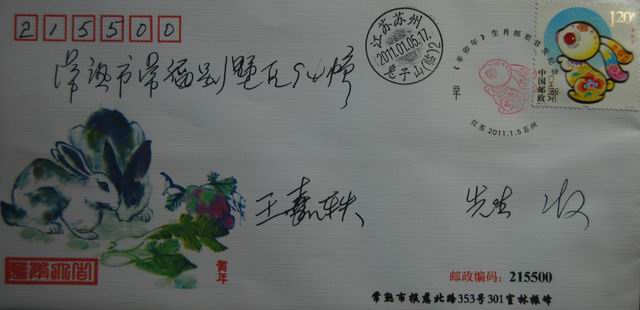
 I got two FDC's during the Chinese New Year, on which there were two different cancellations. Actually, there should be more than one hundred special postmarks on this theme on the first issue day.

 Heilongjiang is a province of the People's Republic of China located in the northeastern part of the country. "Heilongjiang" literally means Black Dragon River, which is the Chinese name for the Amur. The one-character abbreviation is 黑 (pinyin: Hēi). The Manchu name of the region is Sahaliyan ula (literally, "Black River"), from which the name of Sakhalin is derived. Heilongjiang borders Jilin in the south and Inner Mongolia to the west; it also borders Russia to the north and east. The Amur River marks the border between the People's Republic of China and Russia to the north. Heilongjiang contains China's northernmost point (in Mohe County along the Amur) and easternmost point (at the junction of the Amur and Ussuri Rivers).

 The Ming Xiaoling Mausoleum is the tomb of the Hongwu Emperor, the founder of the Ming Dynasty. It lies at the southern foot of Purple Mountain, located east of the historical center of Nanjing, China. Legend says that in order to prevent robbery of the tomb, 13 identical processions of funeral troops started from 13 city gates to obscure the real burying site. The construction of the mausoleum began during the Hongwu Emperor's life in 1381 and ended in 1405, during the reign of his son the Yongle Emperor, with a huge expenditure of resources involving 100,000 laborers. The original wall of the mausoleum was more than 22.5 kilometers long. The mausoleum was built under heavy guard of 5,000 military troops.
 Wulingyuan is a scenic and historic interest area in Hunan Province, China, famous for its approximately 3,100 tall quartzite sandstone pillars, some over 800 meters in height, which are a kind of karst formation. It is part of Zhangjiajie city, about 270km from the capital of Hunan Province, Changsha. It lies between the coordinates of 29°16′0″N 110°22′0″E / 29.266667°N 110.366667°E / 29.266667; 110.366667Coordinates: 29°16′0″N 110°22′0″E / 29.266667°N 110.366667°E / 29.266667; 110.366667 and 29°24′0″N 110°41′0″E / 29.4°N 110.683333°E / 29.4; 110.683333. It was designated a UNESCO World Heritage Site in 1992. Wulingyuan forms part of the Wuling Range.
 This post office is quite near to my university, and I always sent registered mails and FDC's there.

 Taihu Lake is a large lake in the Yangtze Delta plain, on the border of the Jiangsu and Zhejiang provinces in the People's Republic of China. The waters of the lake belong to the former in its entirety with part of its southern shore forming the boundary between the two provinces. With an area of 2,250 km² and an average depth of 2 metres, it is the third largest freshwater lake in China, after the Poyang and Dongting Lakes. The lake houses about 90 islands, ranging in size from a few square meters to several square miles.
 Last winter I visited this city in the North of Jiangsu Province, East China and took this picture of this post office located in the center of the city.

 It's a campus card showing Beijing No.8 Middle School,which is a highly prestigious public beacon secondary school (Grade 7-12) located in Xicheng District, Beijing, People's Republic of China.
 I went to Xiamen by the end of June for a short travel. And there I made this registered cover for myself, on which I affixed a set of three stamps showing this small island issued in 2003. Gulangyu is a car free island off the coast of Xiamen, Fujian province in southern China, about 2km2 in area. It is home to about 20,000 people and is a very popular tourist destination. Visitors can reach it by ferry from Xiamen Island in about 5 minutes. Gulangyu Island is renowned for its beaches and winding lanes and its varied architecture. The island is on China's list of National Scenic Spots and also ranks at the top of the list of the ten most-scenic areas in Fujian Province.

 Guangzhou, in English and other European languages also known as Canton (which was first romanized from the Cantonese pronunciation of Guangdong by the Portuguese) and also known as Kwangchow, is a sub-provincial city located in southern China in the middle of Guangdong Province north of the Pearl River, about 120 km (75 mi) northwest of Hong Kong. It is the third largest city in China and the capital of Guangdong Province, southern China's largest city and key transportation hub and trading port, located on the Pearl River which is navigable to the South China Sea. As of the 2000 census, the city has a population of 6 million, and an urban area population of roughly 11.85 million, making it the most populous city in the province and the third most populous metropolitan area in China.

 The Wuyuan county is an administrative district of the province of Jiangxi, China. It is under the jurisdiction of the prefecture-level city of Shangrao. Wuyuan, on the boundary of three provinces in Jiangxi's northeastern corner, has a magnificent landscape dotted with strange caves, deep secluded rocks and numerous historic sites. It has been described by some overseas photographers as the "most beautiful of Chinese villages. Wuyuan County is home to some of the best-preserved ancient architecture in China. Each of the numerous ancient buildings has a distinctive shape and structure. They emerge from among the emerald green mountains, clear rivers, green trees and the crisscrossing paths between the fields.
 Shangri-La is a fictional place described in the 1933 novel Lost Horizon by British author James Hilton. In the book, "Shangri-La" is a mystical, harmonious valley, gently guided from a lamasery, enclosed in the western end of the Kunlun Mountains. Shangri-La has become synonymous with any earthly paradise but particularly a mythical Himalayan utopia — a permanently happy land, isolated from the outside world. In the novel Lost Horizon, the people who live at Shangri-La are almost immortal, living years beyond the normal lifespan and only very slowly aging in appearance. The word also evokes the imagery of exoticism of the Orient. In the ancient Tibetan scriptures, existence of 7 such places are mentioned as Nghe-Beyul Khimpalung. One of such places is mentioned to be situated somewhere in the Makalu-Barun region.


.jpg)


